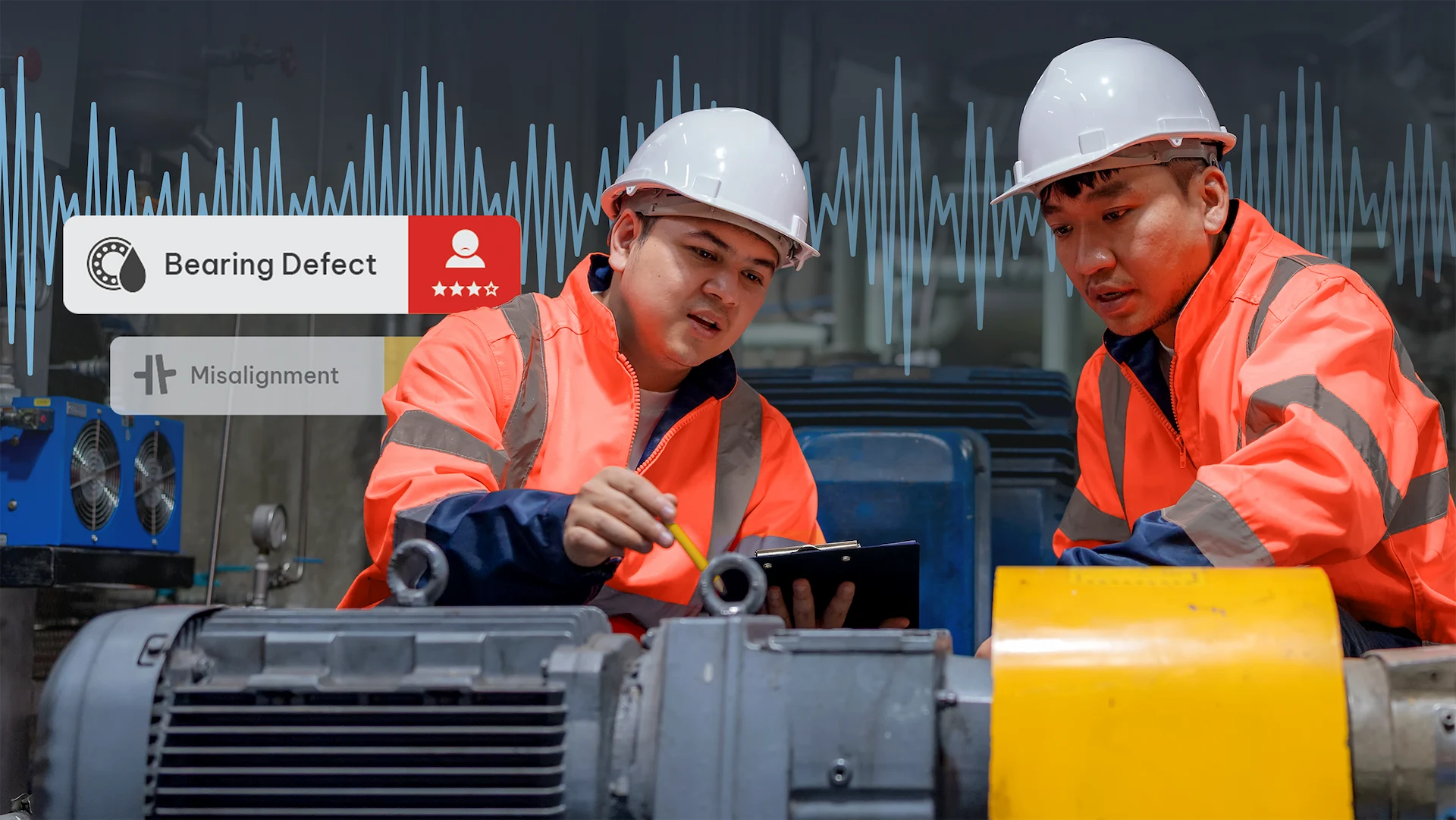


Many machine failures begin with a small defect inside a rolling element bearing. Because bearings are among the most common components in rotating machinery, they are also one of the most common sources of mechanical failure. Bearing failures can occur due to a variety of mechanisms, including fatigue or spalling, improper lubrication, contamination, brinelling or false brinelling, electrical pitting, improper mounting, or misalignment. When defects develop within a bearing, they create repeating impacts as the internal components interact during rotation. Depending on where the defect occurs within the bearing, these impacts generate vibration at specific, predictable frequencies known as bearing fault frequencies. By identifying these frequencies through vibration analysis, maintenance teams can detect developing bearing damage long before it leads to machine failure.
Why Bearing Fault Frequencies Exist
Rolling element bearings operate through repeated mechanical interactions between the inner race, outer race, rolling elements, and cage. As the shaft rotates, the rolling elements continuously pass over the raceways while the cage guides their motion around the bearing. These interactions occur in predictable patterns determined by the bearing’s geometry and the rotational speed of the shaft.
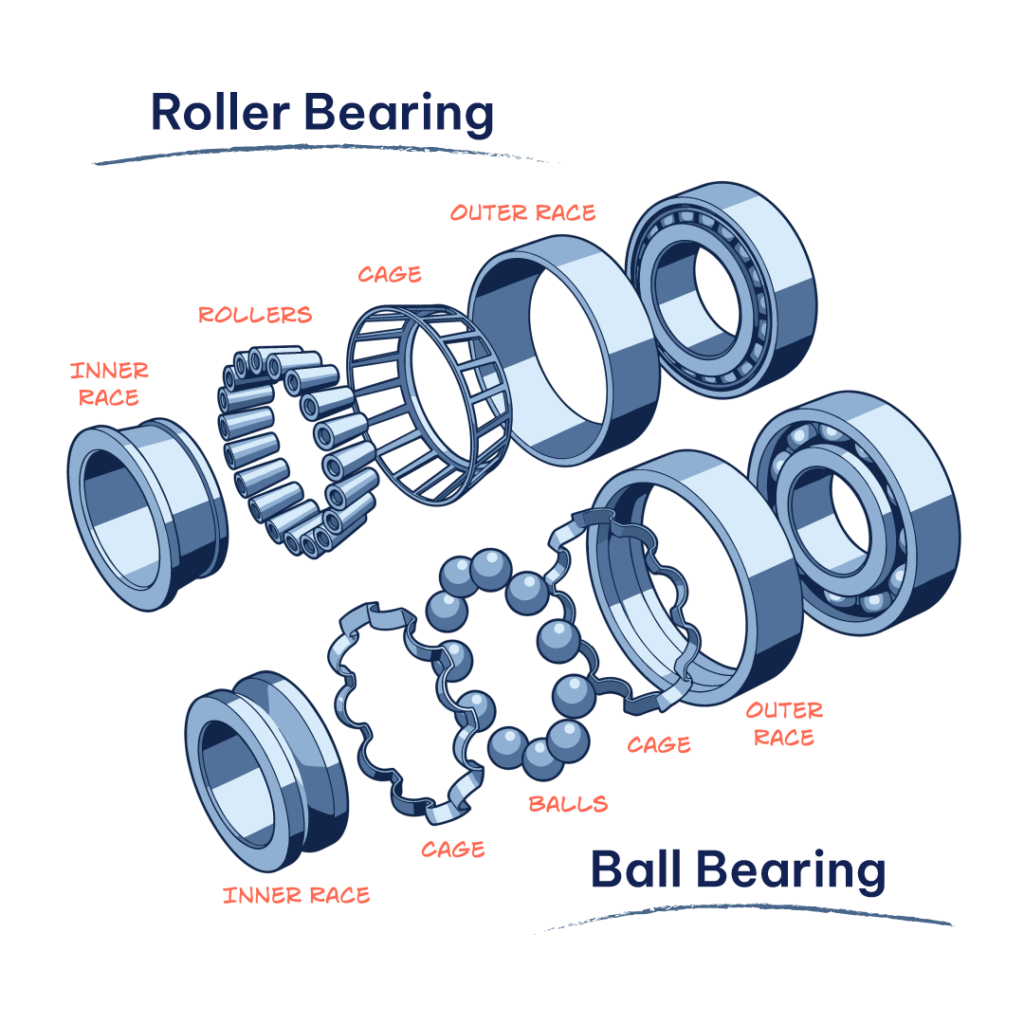
When a defect develops on any of these surfaces, each rolling element passing over the damaged area produces a small impact. Because the motion of the bearing components is repetitive, these impacts occur at regular intervals. The result is vibration at specific frequencies related to the number of rolling elements, the diameter of the rolling elements, the pitch diameter of the bearing, the contact angle, and the rotational speed of the shaft.
These repeating impact rates form what are known as bearing fault frequencies, which are calculated characteristic frequencies associated with specific bearing components. In practice, the observed frequencies may vary slightly from their theoretical values due to load, contact angle, and bearing geometry. By understanding how these frequencies are generated, analysts can use them as diagnostic indicators of developing bearing damage.
The four most common bearing fault frequencies are BPFO (Ball Pass Frequency Outer Race), BPFI (Ball Pass Frequency Inner Race), BSF (Ball Spin Frequency), and FTF (Fundamental Train Frequency). Because each frequency is associated with a different component within the bearing, identifying them in vibration data can help analysts determine not only that a bearing fault exists, but also which part of the bearing is likely damaged.
The Four Primary Bearing Fault Frequencies
Each of the four bearing fault frequencies corresponds to a specific component within the bearing and reflects the rate at which impacts occur when a defect is present. By understanding what each frequency represents, vibration analysts can better interpret vibration data and narrow down the location of potential bearing damage.
BPFO – Ball Pass Frequency Outer Race
BPFO stands for Ball Pass Frequency Outer Race and describes the rate at which rolling elements pass over a fixed point on the outer race of a bearing. This frequency is associated with damage on the outer raceway, which is typically stationary within the bearing housing.
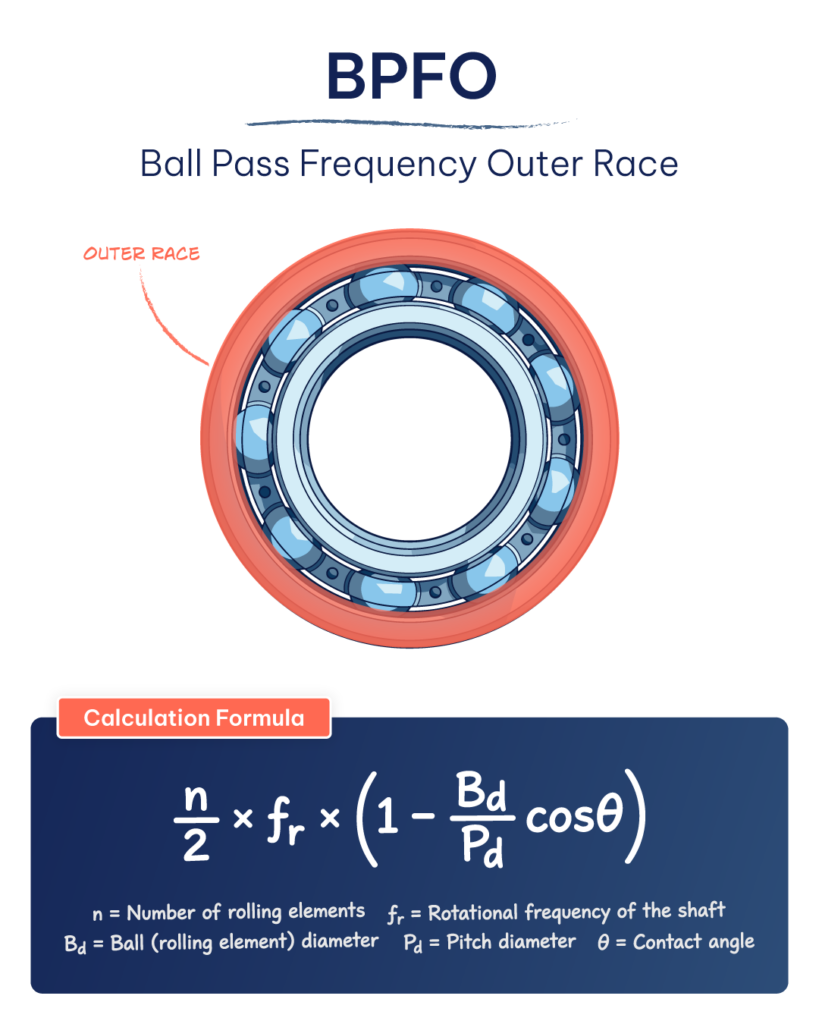
When a defect develops on this surface, each rolling element that passes over the damaged area produces a small impact that generates vibration. Because the outer race is stationary relative to the housing, defects often develop within the bearing’s load zone, where the rolling elements repeatedly pass under load.
Outer race defects may develop due to common bearing failure mechanisms such as fatigue, contamination, lubrication issues, or damage during installation.
Because the outer race remains stationary relative to the housing and the vibration sensor, these impacts tend to occur at very consistent intervals. This often produces a stable vibration pattern that is relatively easy to detect once the fault develops, making BPFO-related defects among the more straightforward bearing faults to identify using vibration analysis.
BPFI – Ball Pass Frequency Inner Race
BPFI stands for Ball Pass Frequency Inner Race and represents the rate at which rolling elements pass over a point on the inner race of the bearing. This frequency is associated with defects on the inner raceway, which rotates with the shaft.
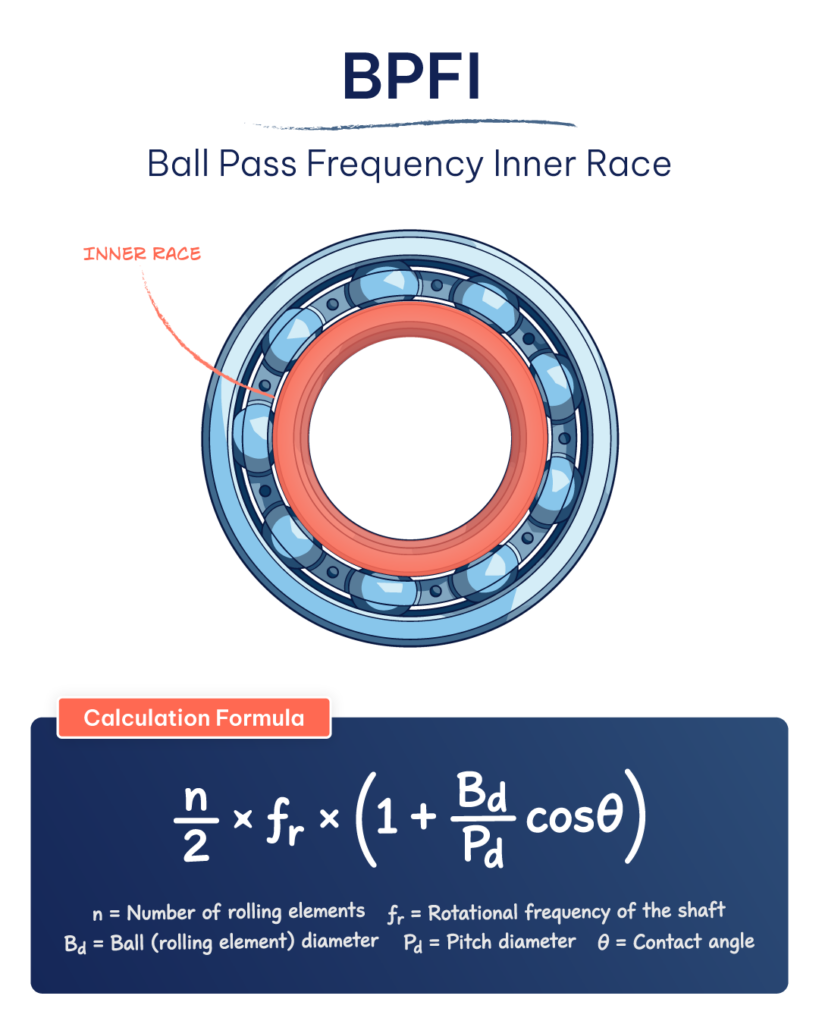
As the shaft turns, the damaged portion of the race moves with the inner race while the rolling elements repeatedly pass over it, generating vibration impacts. Because the defect rotates with the shaft, it periodically moves into and out of the bearing’s load zone as the shaft turns.
Inner race defects may develop due to common bearing failure mechanisms such as fatigue, improper mounting, lubrication breakdown, or contamination within the bearing.
From a vibration analysis perspective, this changing interaction with the load zone often causes the vibration signal to become amplitude modulated at shaft rotational speed. As a result, inner race defects frequently appear in vibration spectra as BPFI with sidebands spaced at 1× running speed, which can help analysts distinguish them from outer race defects.
BSF – Ball Spin Frequency
BSF stands for Ball Spin Frequency and describes the rate at which each rolling element spins around its own axis as it travels between the inner and outer raceways. This frequency is associated with damage on the rolling elements themselves, such as the balls or rollers within the bearing.
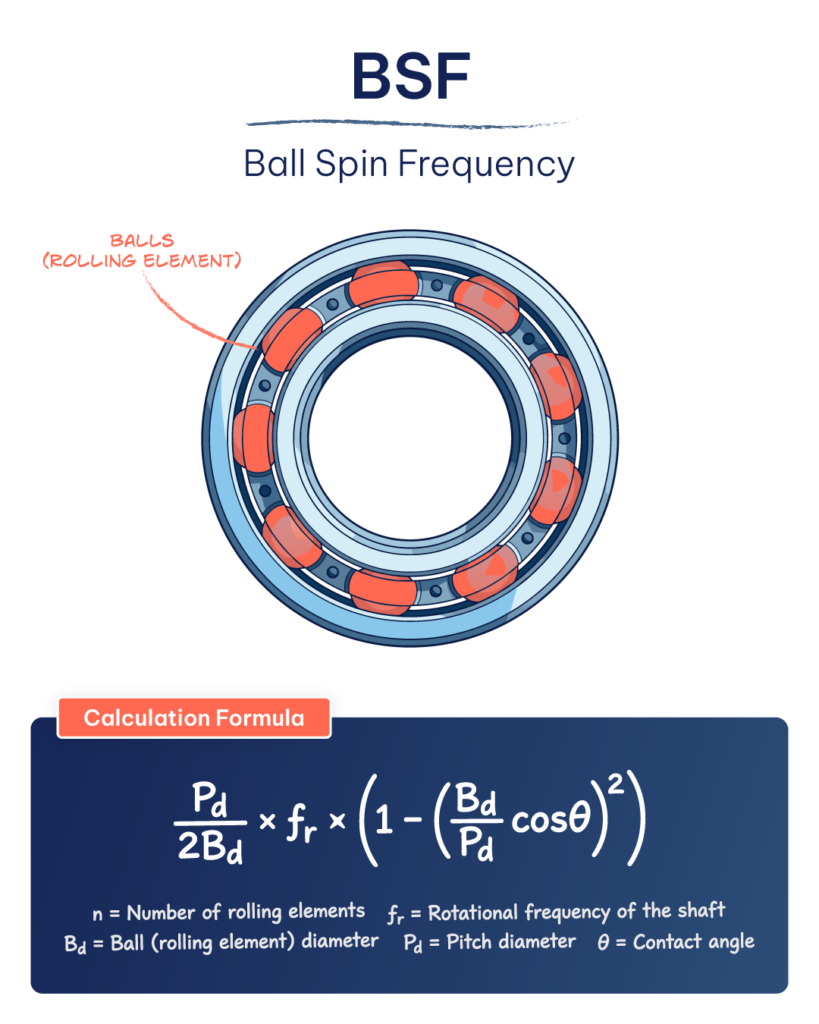
When a defect forms on a rolling element, impacts are generated as the damaged area contacts the raceways during rotation. In practice, rolling-element faults may appear at BSF, its harmonics, or sometimes at 2×BSF.
Rolling element defects may occur due to common bearing failure mechanisms such as fatigue, contamination, lubrication problems, or excessive loading.
Because rolling elements both rotate on their own axis and orbit around the bearing with the cage, BSF-related vibration can sometimes appear with sidebands spaced at the Fundamental Train Frequency (FTF). This interaction can produce more complex vibration patterns than raceway defects, which can make rolling-element faults more difficult to detect in their early stages.
FTF – Fundamental Train Frequency
FTF stands for Fundamental Train Frequency, often referred to as the cage frequency, and represents the rotational speed of the bearing cage that holds and spaces the rolling elements.
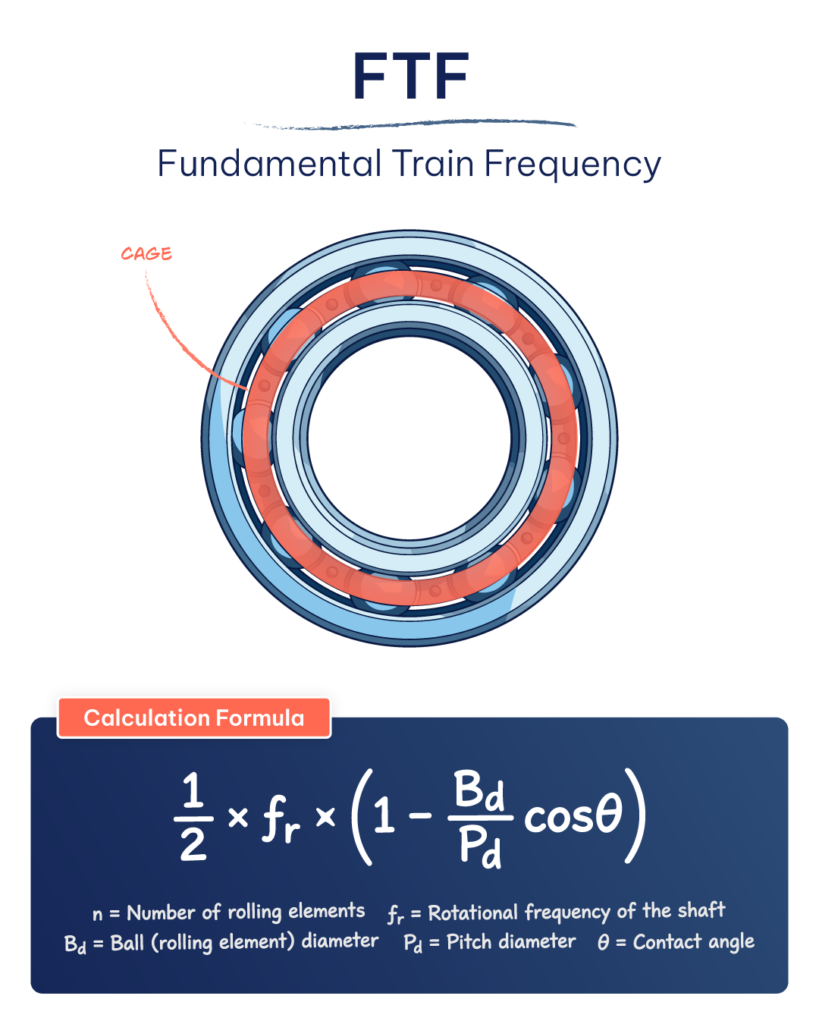
This frequency is associated with issues involving the bearing cage, which maintains proper spacing and guidance of the rolling elements as they move around the bearing.
Cage-related problems may develop due to lubrication issues, wear, contamination, or instability within the bearing assembly.
Because the cage rotates more slowly than the shaft and rolling elements, the Fundamental Train Frequency typically occurs at a much lower frequency than the other bearing fault frequencies. As a result, cage-related issues often appear at low frequency, and FTF may also show up as sideband spacing around other bearing frequencies.
In vibration analysis, cage-related activity may sometimes appear not only at FTF itself, but also as sidebands around other bearing fault frequencies spaced at the cage frequency. This modulation occurs because the cage governs the spacing and motion of the rolling elements as they circulate around the bearing.
Using Bearing Fault Frequencies in Vibration Analysis
In vibration analysis, bearing fault frequencies provide a valuable reference point for diagnosing developing bearing problems. By comparing calculated fault frequencies to peaks observed in vibration data, analysts can often determine whether vibration is coming from a bearing and identify which component of the bearing may be damaged.
While these frequencies can help pinpoint where impacts are occurring within the bearing, they do not necessarily reveal the root cause of the damage. Issues such as lubrication problems, contamination, improper installation, or excessive loading may all lead to defects in the bearing. For this reason, bearing fault frequencies are most effective when used as part of a broader reliability strategy that combines vibration analysis with inspection, lubrication practices, and proper installation procedures.
When used correctly, these frequencies allow maintenance teams to detect bearing defects earlier, investigate their root causes, and prevent minor damage from developing into costly machine failures.
Diagnose bearing faults with confidence:
Explore the Acoem Falcon Portable Vibration Analyzer
Calculate BSF, BPFI, and BPFO (Click on the “Calculator: Bearings” dropdown):
Try the Mobius Bearing Defect Frequency Calculator