

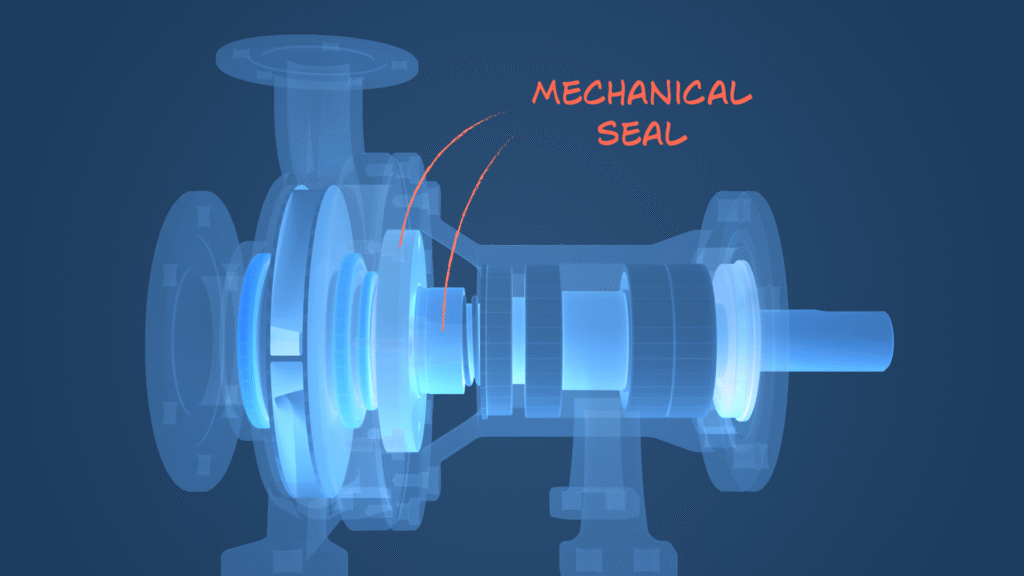
Mechanical seals are leakage-control devices used on rotating equipment such as pumps and mixers to minimize fluid leakage where a shaft passes through a housing. Widely used in industrial process systems, they play a critical role in improving pump reliability and overall equipment performance.
Mechanical seals consist of precision-lapped rotating and stationary faces that work together to form the primary sealing interface. These faces operate with a thin fluid film, which provides lubrication, reduces wear, and enables controlled sealing during operation.
Refer to the image below to see where mechanical seals are located within a centrifugal pump.
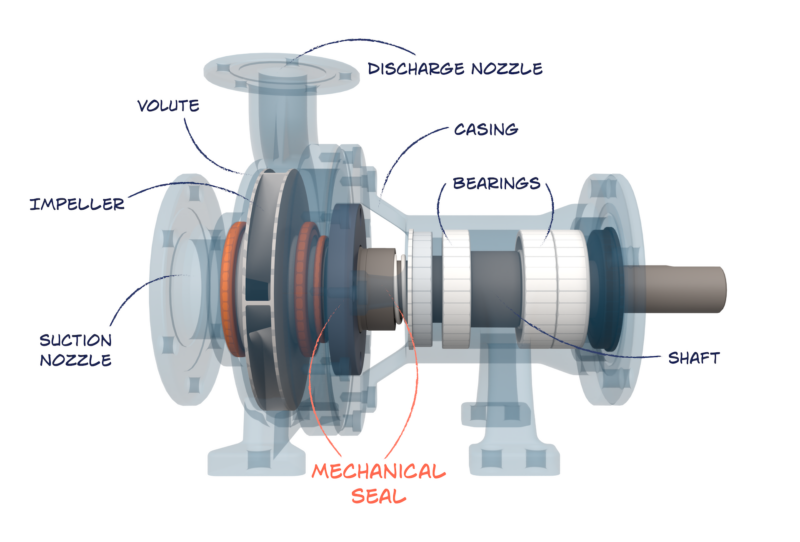
A mechanical seal has two primary sealing elements: a rotating seal face and a stationary seal face. These faces create the main sealing interface. In addition to these primary elements, a complete seal assembly includes secondary sealing elements, load components (springs or bellows), and drive mechanisms that work together to maintain sealing performance.
Mechanical seals are available in a range of designs, from single-spring seals to cartridge seals, each suited for specific operating conditions. Seal design and material selection are based on factors such as pressure, temperature, shaft speed, and process fluid compatibility.
Proper seal selection is essential for maintaining seal face integrity, minimizing leakage, and supporting long-term equipment reliability.
7 Main Components of a Basic Mechanical Seal
A mechanical seal assembly includes several components that work together to control leakage and maintain proper sealing conditions. If any one of these components is installed incorrectly or fails, overall seal performance will be compromised.
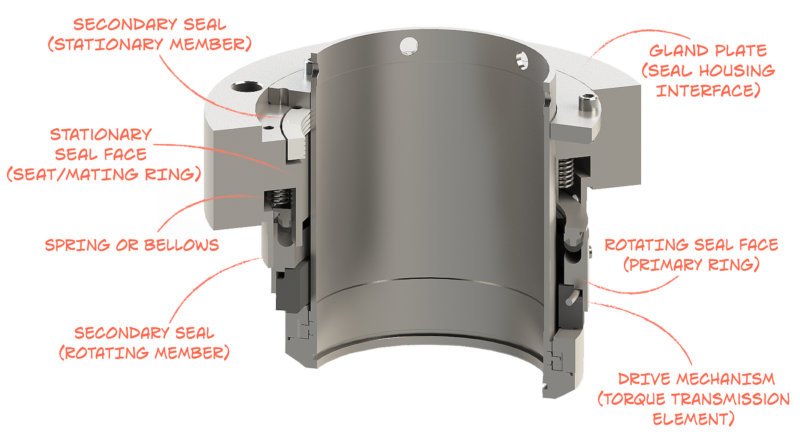
1. Rotating Seal Face (Primary Ring)
The rotating seal face is mounted on and rotates with the shaft or shaft sleeve. It forms one half of the primary sealing interface and is precision-lapped to maintain flatness. This component works against the stationary seal face to control leakage while operating with a thin lubricating fluid film.
2. Stationary Seal Face (Seat / Mating Ring)
The stationary seal face is fixed within the seal housing or gland plate and does not rotate. It provides the opposing precision-lapped surface that mates with the rotating seal face. Together, these two faces form the primary seal where leakage is controlled.
3. Secondary Seal (Rotating Member)
This is typically an elastomer (such as an O-ring, bellows, or wedge) located between the rotating seal face and the shaft or sleeve. It prevents fluid from leaking along the shaft and allows axial movement of the rotating seal face while maintaining sealing contact.
4. Secondary Seal (Stationary Member)
This sealing element is located between the stationary seal face and the gland plate or housing. It prevents leakage around the outside diameter of the stationary seal face and blocks fluid from bypassing the primary sealing interface.
5. Spring or Bellows (Load Element)
The spring or bellows applies a constant axial force that keeps the rotating and stationary seal faces in contact. It compensates for wear, thermal expansion, and minor shaft movement to maintain proper sealing pressure during operation.
6. Drive Mechanism (Torque Transmission Element)
The drive mechanism transfers rotational motion from the shaft to the rotating seal face. This can include set screws, drive pins, tabs, or other locking features. Its role is to ensure the rotating face turns with the shaft without slipping while maintaining correct positioning.
7. Gland Plate (Seal Housing Interface)
The gland plate mounts the mechanical seal to the equipment and secures the stationary components in place. It also provides ports for flush, drain, or quench connections, which help control temperature, remove contaminants, and support seal performance in demanding applications.
The Sealing Points
A mechanical seal controls leakage across multiple potential paths. Each sealing point prevents fluid from escaping through a different route within the assembly. If any of these sealing points fail, leakage, equipment damage, and downtime can occur. Refer to the diagram to see where each sealing point is located within a mechanical seal assembly:
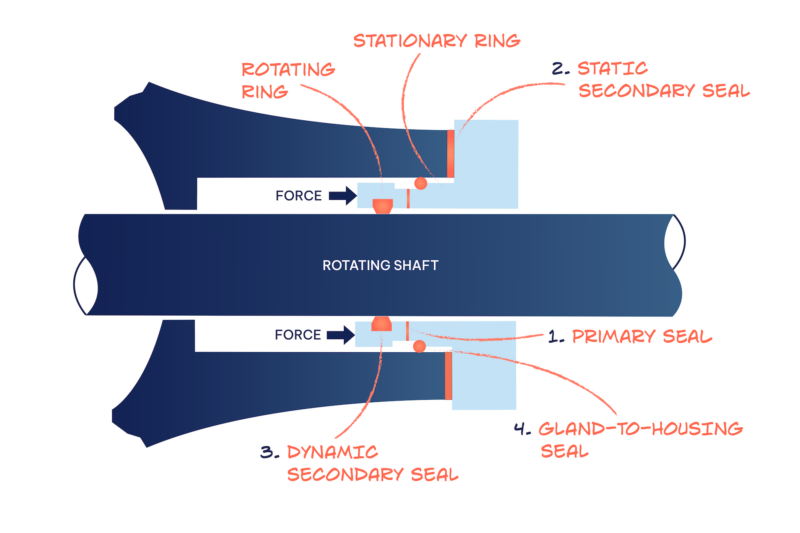
1. Primary Seal (Seal Faces)
The interface between the rotating and stationary seal faces. This is the main sealing point, operating with a thin lubricating fluid film that controls leakage.
2. Static Secondary Seal (Stationary Member)
The seal between the stationary face and the housing or gland plate. Prevents leakage around the outside of the stationary component.
3. Dynamic Secondary Seal (Rotating Member)
The seal between the rotating face and the shaft or sleeve. Prevents leakage along the shaft while allowing axial movement.
4. Gland-to-Housing Seal
The seal between the gland plate and the stuffing box or seal chamber. Prevents external leakage at the mounting interface.
Proper Handling and Cleanliness
Mechanical seals must be handled with care to maintain sealing performance. The seal faces are precision-lapped and highly sensitive to contamination and damage. Follow manufacturer handling instructions at all times.
Best Practices:
1. Use clean hands or gloves
Prevent contamination from oils, grease, or debris.
2. Keep seals free from dust and debris
Even small particles can damage sealing faces and lead to leakage.
3. Avoid dropping the seal
Mechanical seals are precision components. Impact can damage internal parts and compromise performance.
Installation and Assembly
Mechanical seal reliability depends heavily on proper installation. Errors during assembly can lead to immediate leakage or early failure.
1. Prepare the Equipment
- What to do:
- Clean the shaft, sleeve, and seal chamber thoroughly. Remove burrs, corrosion, and debris.
- Why it matters:
- Surface damage or contamination can cut elastomers, mis-seat components, and create immediate leak paths.
2. Verify Shaft Condition
- What to do:
- Check shaft runout, surface finish, and dimensional tolerances before installing the seal.
- Why it matters:
- Excessive runout or poor surface condition prevents proper sealing and leads to uneven face wear.
3. Install Secondary Seals Properly
- What to do:
- Lightly lubricate O-rings or elastomers with a compatible lubricant and install without twisting or rolling.
- Why it matters:
- Damaged or improperly seated secondary seals will leak along the shaft or around stationary components.
4. Position Components Correctly
- What to do:
- Install the rotating and stationary components in the correct orientation and sequence per the manufacturer’s instructions.
- Why it matters:
- Incorrect positioning can prevent proper face contact and cause immediate seal failure.
5. Set the Correct Installation Length
- What to do:
- Set the seal to the specified axial position (setting dimension) and remove any setting clips if required.
- Why it matters:
- Incorrect setting changes spring load and face pressure, leading to overheating, wear, or leakage.
6. Secure the Drive Mechanism
- What to do:
- Tighten set screws or drive features evenly to lock the rotating components to the shaft.
- Why it matters:
- Improperly secured components can slip, causing loss of rotation and seal failure.
7. Install and Tighten the Gland Plate
- What to do:
- Mount the gland plate and tighten fasteners evenly in a cross-pattern to the specified torque.
- Why it matters:
- Uneven tightening can distort the seal, misalign faces, and create leak paths at the housing interface.
8. Final Check Before Startup
- What to do:
- Verify all components are seated, fasteners are tightened, and the seal faces are clean before rotating the shaft.
- Why it matters:
- A quick final check prevents startup damage and ensures proper seal operation from the first run.
Install it right the first time, and it runs. Miss a step, and you’ll be back pulling it apart.
Mechanical Seal Key Takeaways
Mechanical seals are designed to control leakage by managing multiple sealing interfaces within the assembly. From the primary seal faces to the secondary sealing elements and support components, each part plays a role in maintaining sealing performance under operating conditions.
When properly selected, installed, and maintained, mechanical seals provide reliable leakage control, protect equipment, and support long-term operation in pumps and rotating equipment.
A clear understanding of seal components, sealing points, and installation practices allows maintenance teams to reduce failures, improve reliability, and extend seal life.
Keep Learning. Keep Improving.
Want to get more out of your equipment and your skills?
🔧 Explore more maintenance tips and reliability insights on our blog.
🎥 Watch real-world training and how-to videos on our YouTube Channel.
⚙️ Learn from the field with practical guidance built for technicians and engineers.
Whether you’re troubleshooting a failure or dialing in precision, we’ve got the resources to help you get it done right.