
Why reliability starts where “good enough” ends
Every maintenance task has a point where approximation becomes verified, repeatable reliability. That point is the Precision Threshold.
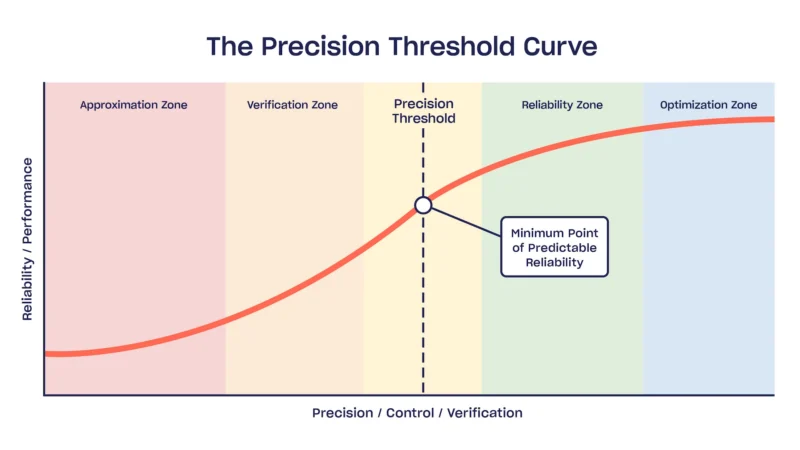
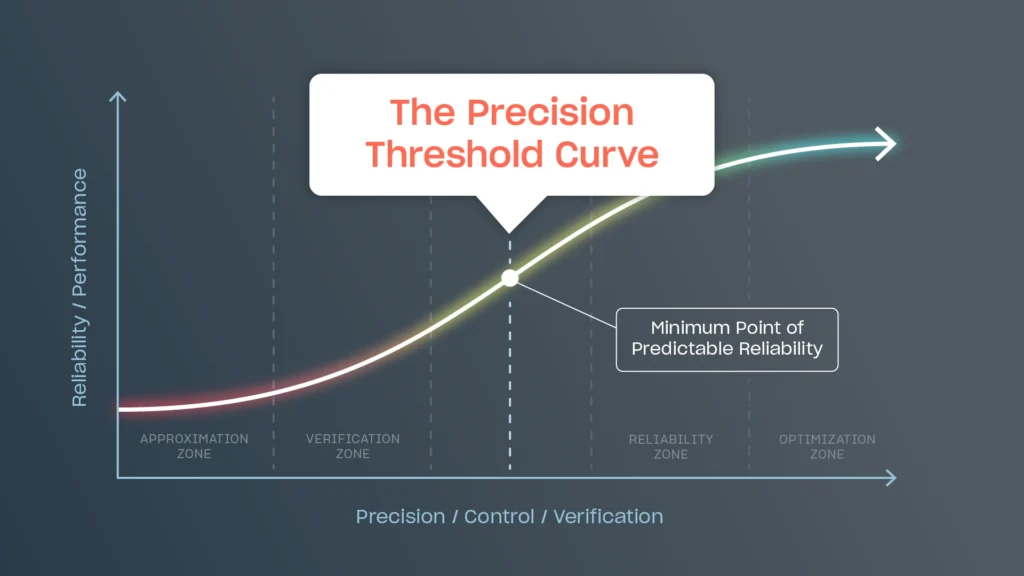
Figure 1. The Precision Threshold framework for evaluating where a maintenance task sits on the path from approximation to verified reliability.
The line we already understand
Imagine you are building your house.
You have two carpenters in front of you. One measures every cut to the nearest eighth of an inch. The other measures to the nearest sixteenth. Which one do you want working on your house?
Now think about your mechanic. One torques critical fasteners to the manufacturer’s specification. The other says, “I have done this long enough. I can feel it.” Which one gets your car?
What about the electrician wiring your home? The HVAC technician installing your furnace? The contractor setting the foundation your family will live on?
Without even thinking about it, we all understand the same basic truth: precision matters.
We expect it when the work touches our homes, our cars, our families, and our money. We trust the person who measures, verifies, and proves the work was done right.
So here is the question that bothers me: why do we demand precision on a furnace, a vehicle, or a house, but accept approximation on a motor, pump, fan, gearbox, or production asset worth many times more?
That gap deserves a name.
I call it the Precision Threshold.
What the Precision Threshold means
The Precision Threshold is the point where “good enough” becomes predictably reliable.
It is not a tool. It is not a brand. It is not a sales pitch. It is a way to evaluate a decision before that decision becomes a failure.
Every maintenance activity sits somewhere on a curve between approximation and verified precision. Every organization has a position on that curve. Every technician, every job plan, and every standard either moves the work toward precision or leaves it in the gray area of assumption.
The question is not whether your plant has a Precision Threshold. The question is whether you have identified it.
A belt drive is a simple place to see it
Take belt-driven equipment. This is not theory. People in the field make this choice all the time.
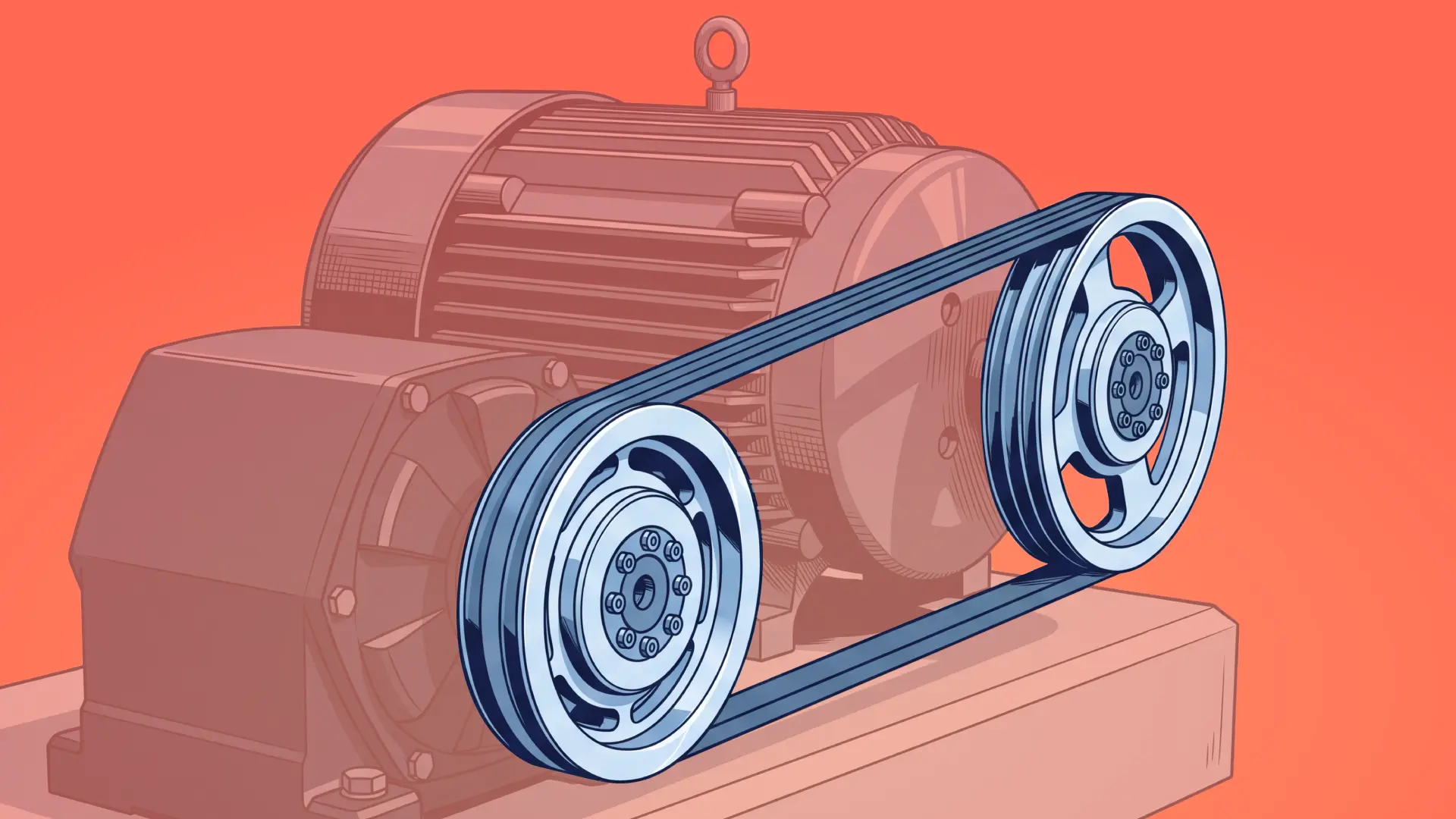
One technician aligns sheaves with a string and straightedge. Another verifies alignment with a laser. One tensions the belt by feel with a thumb. Another measures belt tension with a proper gauge, even a simple spring-loaded one.
Both machines may start. Both may appear successful. But they are not on the same side of the Precision Threshold.
The difference may not show up in the first minute. It shows up later as heat, belt dust, uneven wear, elevated vibration, shortened bearing life, energy loss, and unplanned downtime.
That is what makes this concept useful. The Precision Threshold is not about making the work fancy. It is about separating work that merely gets a machine running from work that gives the machine a better chance to survive.
The industrial problem is not effort. It is verification.
Most maintenance teams are not lazy. Most technicians are not careless. In my experience, people usually want to do the job right. The problem is that many plants have not clearly defined what “right” means.
If the standard is experience only, then results depend on who happens to be doing the job that day. If the standard is measurement, verification, documentation, and follow-up, the work becomes repeatable.
The U.S. Department of Energy states that optimized shaft alignment is intended to increase the operating life of rotating machinery by keeping likely-to-fail components within acceptable design limits. The same guidance describes misalignment as a source of excessive vibration, noise, increased coupling and bearing temperatures, and premature bearing, coupling, or shaft failure [1].
That is exactly the kind of line the Precision Threshold is meant to expose. Did we align it, or did we verify alignment? Did we tension it, or did we prove tension? Did we repair it, or did we acceptance test it? Did we start it, or did we baseline it? Did we assume it was good, or did we know?
Those are different questions than “Is it running?” Running is not the same thing as reliable.
Failures planted before the machine ever runs
Reliability engineering has long used the bathtub curve to describe failure behavior over time. NIST describes the early failure, or infant mortality, period as a high but rapidly decreasing failure-rate region that can last several weeks to a few months [2]. Texas Instruments also describes the bathtub curve as a visual reliability model with early life, useful life, and wear-out regions, while cautioning that the curve is not usually calibrated to a specific product family [3].
That caution matters. We should not pretend every machine follows the exact same curve. But the practical lesson is still powerful: early-life failures are real, and many are tied to defects, installation issues, contamination, poor setup, or inadequate commissioning.
In plain English, some machines are born with problems. Some are installed with problems. Some are repaired with problems. Some are started without anyone proving they are actually ready to run.
That is where precision has power.
If a machine is misaligned, incorrectly tensioned, poorly balanced, improperly torqued, contaminated, or started without a baseline, the failure may already be planted before production ever begins.
Crossing the threshold takes culture, not just tools
A laser alignment system does not create precision by itself. A vibration analyzer does not create reliability by itself. A torque wrench does not create accountability by itself.
People do. Training does. Standards do. Leadership does.
Crossing the Precision Threshold means building a culture where precision is expected before the machine is handed back to production. It means technicians are trained to understand why the measurement matters, equipped with the tools to do the work correctly, and expected to verify the result before calling the job complete.
That culture includes precision measuring tools, but it also includes acceptance testing, vibration baselines, commissioning checklists, documented results, and follow-up after the machine has had time to run.
A Plant Engineering article on shaft misalignment describes misalignment as a common, costly, and preventable problem in rotating machinery. It also points to workforce changes, budget pressure, training gaps, and the misconception that a coupling can simply “handle” misalignment as reasons precision is often undervalued [4].
That is the heart of this framework. The Precision Threshold gives teams a shared language for deciding where approximation ends and verified reliability begins.
How the Precision Threshold changes the conversation
Instead of saying, “We need better maintenance,” ask: where are we below the Precision Threshold?
Instead of saying, “We need new tools,” ask: what tools would move this task across the Precision Threshold?
Instead of saying, “Training is too expensive,” ask: how much does it cost us to stay below the Precision Threshold?
That is the conversation industry needs. Not because precision sounds good, but because approximation and precision do not produce the same result.
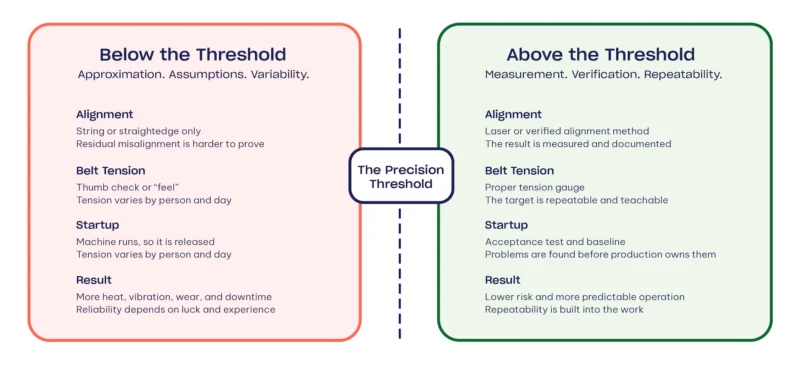
Figure 2. A visual comparison of work that stays below the Precision Threshold versus work that crosses into verified reliability.
Precision is not expensive. Unplanned downtime is.
The goal is not perfection
The goal is not to buy every tool available. The goal is not to turn every maintenance task into a science project. The goal is to stop pretending that approximation and precision produce the same result.
They do not.
Every organization has a Precision Threshold. Some are below it and do not know. Some are above it in certain areas and below it in others. The best organizations are honest enough to measure where they are, disciplined enough to train their people, and smart enough to invest in the tools and practices that move them forward.
The future of reliability will not belong to the companies that simply work harder. It will belong to the companies that understand where “good enough” ends.
That line has a name now.
The Precision Threshold.
References
[3] Texas Instruments, Reliability Terminology: Bathtub Curve
[4] Plant Engineering, How to Avoid Shaft Misalignment in Rotating Machinery