

In rotating machinery, power is commonly transmitted from a driving machine (such as an electric motor or turbine) to a driven machine (such as a pump, compressor, or gearbox) using a shaft coupling. Many of these devices are classified as flexible couplings, but the term “flexible” must be understood in relative and mechanical terms rather than as an absolute characteristic.
All mechanical components respond to applied loads. A solid steel shaft exhibits elastic flexibility under load, just as a rubber band exhibits elasticity, although the magnitude and functional purpose of their flexibility differ significantly.
Fundamental Design Requirements for Couplings
Couplings are engineered to meet multiple performance and reliability requirements for rotating machinery systems.
Key design considerations include:
- Power Transmission Capacity: horsepower or kilowatt requirement
- Torque Transmission: steady-state and transient conditions
- Operating Speed
- Tolerance of Slight Misalignment
- Thermal Effects: relative thermal growth between machines)
- Environmental Conditions: temperature, moisture, dust, chemicals
- Size: to fit where they are used
- Ease of Maintenance
- Durability
- Machine Safety: as a fail-safe mechanism to prevent catastrophic damage
This is part of the reason there are so many different types of couplings, rather than a single universal solution.
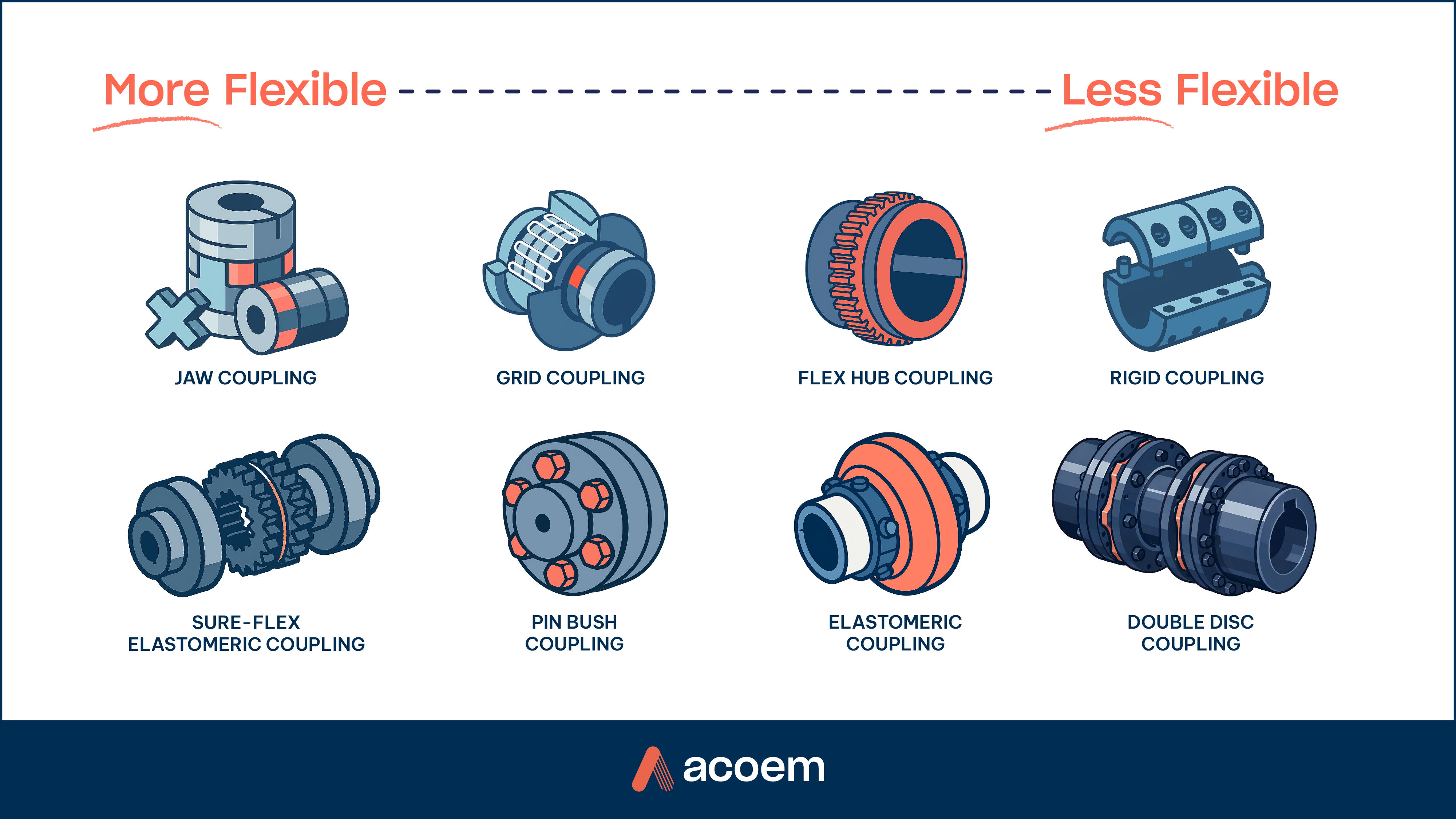
Rigid Couplings
- Can tolerate little to no misalignment.
- Will transfer large amounts of horsepower in a relatively small space.
- Don’t tolerate differing degrees of thermal growth on the machines.
- Tolerate most environmental factors (dirt, dust, water, etc.).
Implications:
Rigid couplings require precise shaft alignment and stable machine foundations. Any misalignment or relative movement is transmitted directly to bearings, seals, and shafts, increasing mechanical stress and reducing component life.
Typical Flexible Couplings
- Can tolerate slight to moderate misalignment.
- Tolerate torsional loads.
- Must be larger than a rigid coupling to transfer the same horsepower.
- Designed to fail before catastrophic damage occurs to either the driving or the driven machine.
- Can tolerate thermal changes in relative machine position (thermal growth).
Implications:
Flexible couplings reduce transmitted forces to connected equipment and help extend bearing and seal life. However, their misalignment capacity is finite and does not eliminate the need for precision shaft alignment.
Coupling Selection for Specific Applications
Each coupling type has its own design characteristics that make it suitable for specific applications. In some applications, slight misalignment along with dynamic movement is the determining factor. For others, the coupling insert is designed to fail before damaging the machine. In others, it’s the amount of horsepower.
For this reason, couplings should be engineered for the application, not just used “because they will fit”.
Engineering Verification and Standards
You should check with your engineering department or the machine manufacturer to make sure the coupling you have is correct for the application. Coordination with the original equipment manufacturer (OEM) or engineering department ensures the selected coupling meets system performance and reliability requirements.
Industry standards and guidance are published by organisations such as ISO, API, and AGMA, which define performance expectations, misalignment limits, and service factors for rotating machinery components.
Key Takeaway
“Flexible” does not imply unlimited tolerance for poor installation or misalignment. Couplings are precision mechanical components whose flexibility is intentionally limited and application-specific. Proper selection and alignment are essential to system reliability, efficiency, and machine life.